 Number 283 - December 2006 |





|
| Distinguishing Forests From Trees In Search Engine Results | |
| Gabe Goldberg, APCUG Advisor,, HCIL Media Fellow October 2006 | |
|
Some people cherish details without grasping the big picture. They can't see the forest for the trees, always miss the landscape's glory. Searching the Web can feel like this. Search engines cheerfully deliver millions of search result hits without revealing patterns or gaps in the data. Even worse, hardly anyone looks beyond the first screen of search results. Researchers are investigating how organizing search results provides contextual and visual cues that make searches more powerful. We all know people who cherish tiny details but never quite grasp the big picture. They're figuratively unable to see the forest for the trees, missing the landscape's glory while obsessing over whatever grows in front of their nose. Sometimes searching the Web feels like this. Google or any favorite search engine can cheerfully deliver a thousand--or two million--search result hits yet not reveal patterns, groupings, or gaps in what it quickly but mindlessly displays. Making things worse, hardly anyone looks at search results beyond the first screen or two; we either settle for one of the first few links, or add search words to prune our results. But this runs two risks. First, we may miss a key Web site that for some reason isn't highly ranked by our search engine. Not everyone knows that search engines rank results using proprietary criteria; even worse, ranking methods often change without notice, so identical searches days or weeks apart may yield very different results. Second, there's no clue or cue about search result patterns. And the human mind can't grasp a thousand--let alone two million--links to see what they might collectively reveal. Enter Bill Kules and Ben Schneiderman, respectively Graduate Research Assistant and Computer Science Professor at the University of Maryland. They're investigating how organizing the display of search results provides contextual and visual cues that make searches more powerful. Their technology, partially supported by an AOL Fellowship in Human-Computer Interaction, is ideal when searchers are unsure of the target or goal. This is a variation on the famous Supreme Court quote: searchers may not know what they're looking for, but they recognize it when they see it. Results, arranged in meaningful and stable categories using structures created by Kules' SERVICE program (as opposed to the ad hoc clustering used by some commercial search engines), are shown in a compact listing in the left side navigation bar. Important text (title, snippet, URL) is arranged for efficient scanning and skimming. SERVICE retains benefits of the traditional ranked results list, while adding an overview. The list allows efficiently scanning and skimming title/snippet/URL--which remains a critical task. The categorized overview adds another perspective on results, showing their distribution across categories. The overview also lets users explore results, narrowing them to a single category or subcategory. Categorizing results is proving to change peoples' search style. For some searchers, the categorized overview simplified formulating queries. They issued a somewhat broad query and then browsed the appropriate category. Others used the overview to organize exploration of results, first perusing results in the Business category, then Science, Health, etc. Other users only used categories when frustrated by normal searching. |
An interesting surprise is that empty categories--which might have been expected to include results--are in fact meaningful in some searches. For more information visit, www.cs.umd.edu/hcil/categorizedsearch. This article originated on the University of Maryland's Human-Computer Interaction Laboratory Web site, http://www.cs.umd.edu/hcil/, and is copyrighted by the university. All rights are reserved; it may be reproduced, downloaded, disseminated, or transferred, for single use, or by nonprofit organizations for educational purposes, with attribution to the university. It should be unchanged and this paragraph included. Please e-mail Gabe Goldberg at gabe@gabegold.com when you use it, or for permission to excerpt or condense. 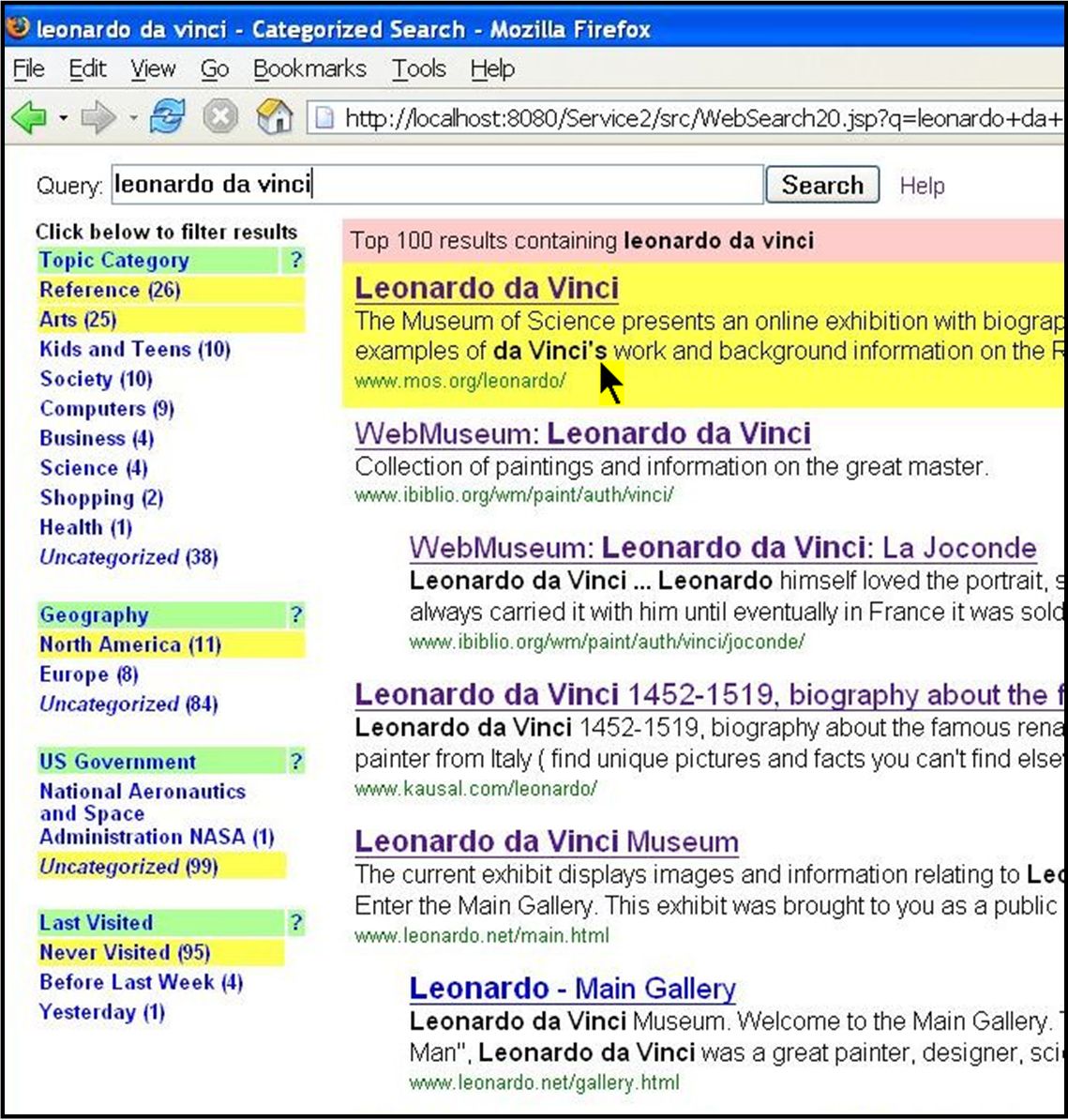
TOGGLE Editor's Note A Google search of the authors' names yielded an interesting site www.hyperradiant.net/blog/archives/emerging_tech/ on the completely different subject of manipulating audio. Play it--you'll like it. |
|
Number 283 - December 2006
|
|